Network is up

Pay for what you use.
Nothing more.

One simple plan: Rs 1 per GB. No monthly fee, no contract, no data cap, no surprises. Dedicated 500+ Mbps speed that's yours alone — never shared with the rest of the building.

Your bandwidth is dedicated — yours alone.
Your line is never shared with the building. Dedicated speed means your stream doesn't buffer, your call doesn't drop, and your download doesn't crawl — regardless of what everyone else is doing.
Optional add-ons
🔌
Wired Ethernet
Rs 100 / month

A dedicated LAN cable run to your room. Lower, steadier ping than Wi-Fi — noticeably better for gaming, video calls and large downloads. Data is still billed at Rs 1/GB.

📡
Dedicated router
Rs 500 / month

Your own router in your room, so you can connect as many devices as you like under one account — phones, laptops, TV, all at once. Ideal for families and shared rooms. Data billed at Rs 1/GB combined.

💡
Add-ons are billed monthly on top of your usual Rs 1/GB data. You can add or drop them anytime — just message us.
First-time setup

Getting online.

Four short steps. Do the first two once, and connecting after that takes seconds. If anything looks different from the pictures, message us — we're on WhatsApp.

Connect to the Wi-Fi
1
Find both networks
Open your Wi-Fi settings. You'll see two networks — connect to whichever is stronger first, then the other:
NizamiNet - Nizami Complex  — older phones & 2.4 GHz (Wi-Fi 4)
NizamiNet_5G - Nizami Complex  — faster, for Wi-Fi 5 / 6 devices
📱
Older devices may only show the first one — that's fine, just use it. Newer devices should connect to both so they always pick the best band.
Turn off "random MAC" — the important step
⚠️
Your account is tied to your device's real (permanent) MAC address. If your phone uses a randomized MAC, only one network will work — or you won't be able to log in at all. Set it to your device / permanent MAC on both networks. This is the step people most often miss.
On most Samsung / Android phones:
  1. Go to Settings › Connections › Wi-Fi.
  2. Tap the ⚙️ gear icon next to the connected network.
  3. Tap View more / Advanced.
  4. Tap MAC address type and change it from Randomized to Phone MAC / Device MAC.
  5. Repeat for the second network too.
On iOS / iPadOS:
  1. Open Settings › Wi-Fi.
  2. If you're not connected yet, tap Edit at the top-right.
  3. Tap the ⓘ More Info button beside the network.
  4. Tap Private Wi-Fi Address and set it to Offnot Fixed and not Rotating.
  5. Do the same for the other network.
🍏
On iOS, Fixed still gives a private per-network address that isn't your real MAC — so it won't work. It has to be Off.
Windows, macOS and Linux use the real hardware MAC by default, so there's usually nothing to change. If you (or your VPN / privacy app) enabled MAC randomization, turn it off for this network:
  • Windows 11: Settings › Network & internet › Wi-Fi › (network) › Random hardware addresses → Off.
  • macOS: Wi-Fi settings are per-network; leave Private Wi-Fi Address Off for our networks.
Open the login page
3
Wait for the sign-in page
Right after connecting, the login page usually opens on its own, or you'll get a “Sign in to Wi-Fi network” notification — tap it. If nothing appears after a few seconds, open your browser and go to:
🔗
Or type it by hand: http://neverssl.com (with http, not https). It's a plain page that forces the login screen to pop up.
Log in — pick your route
The login screen looks like this. What you tap next depends on who you are:
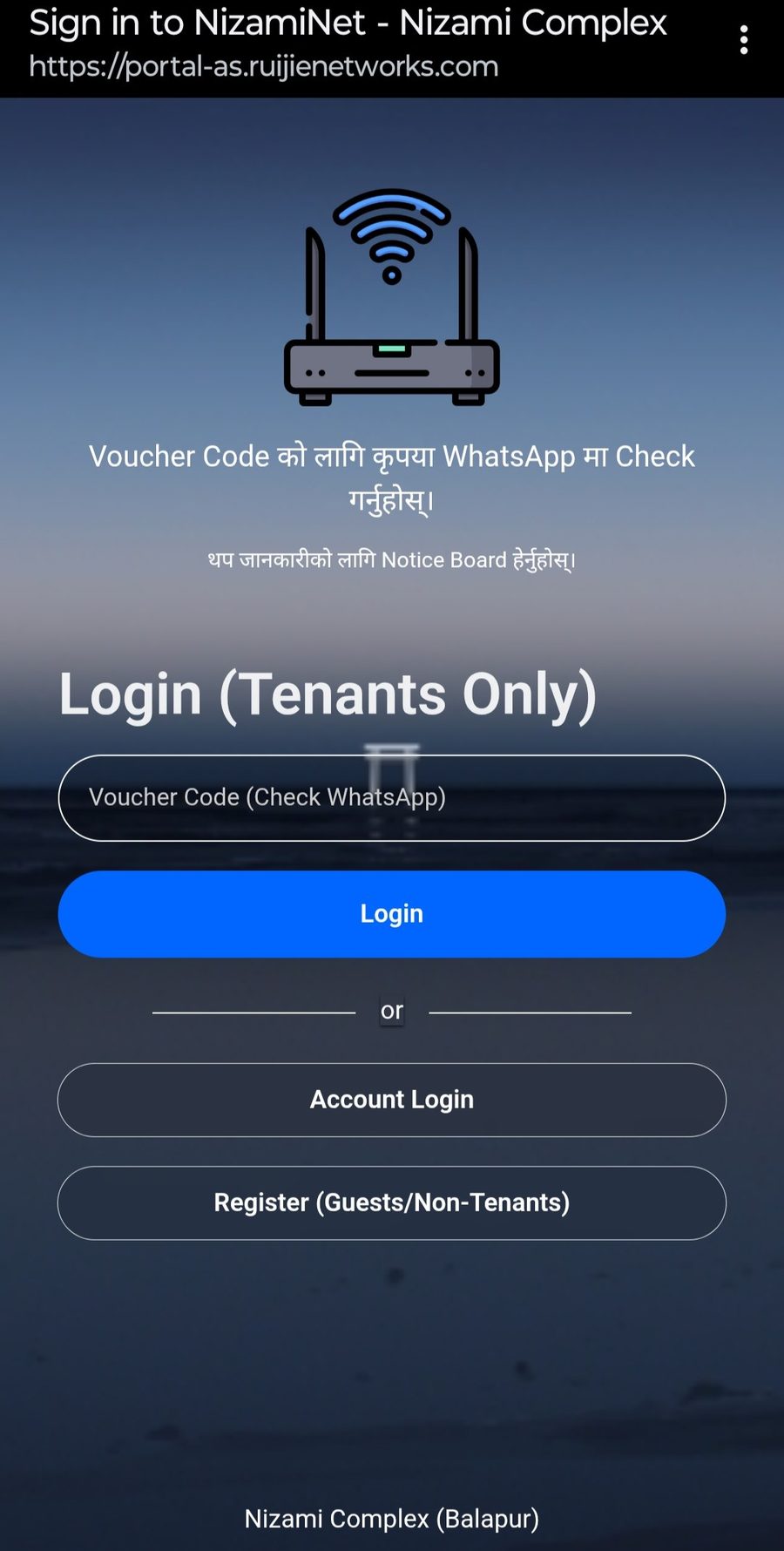
NizamiNet main login screen
Main screentenants tap Account, guests tap Register.
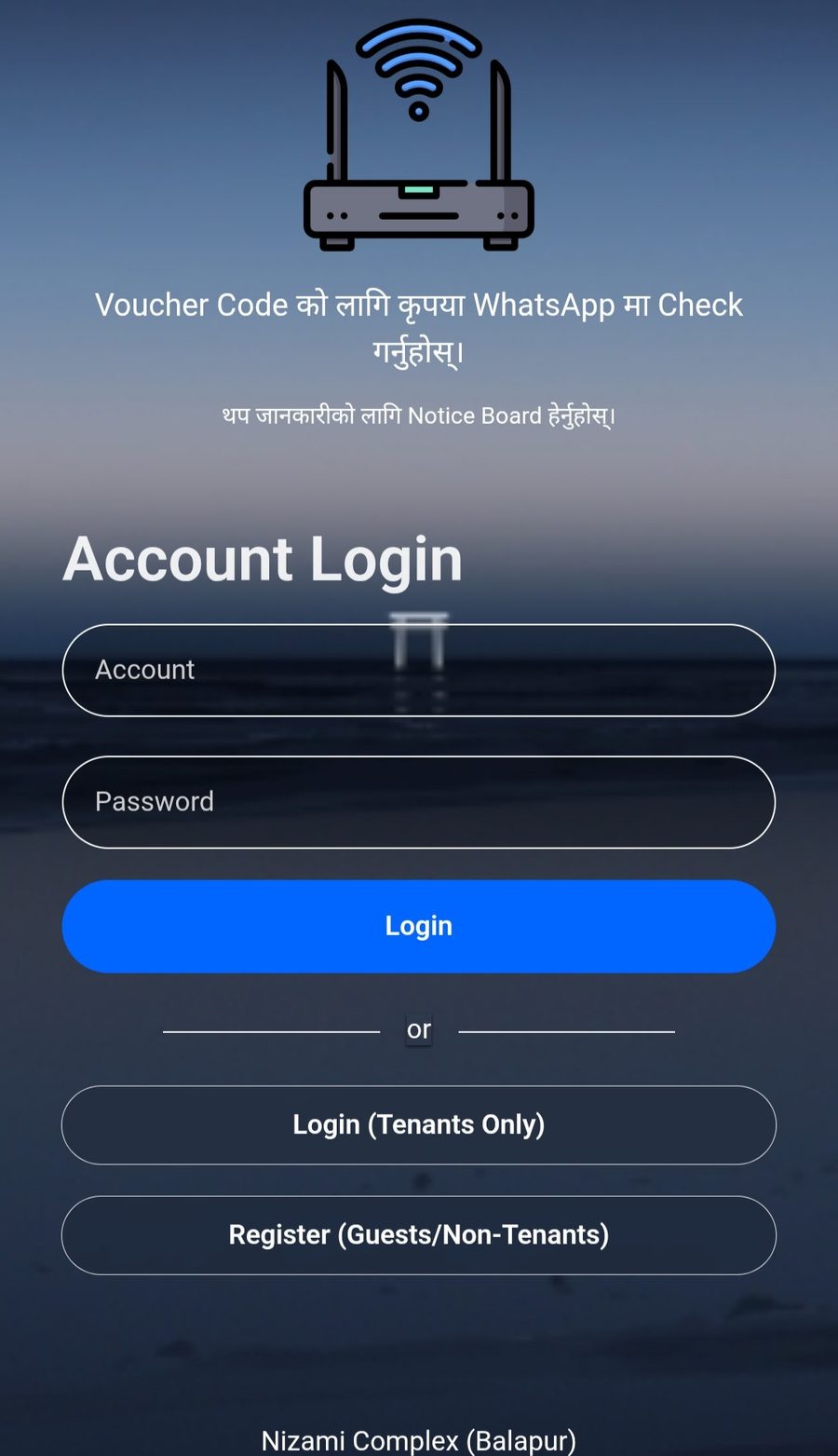
Account login with username and password
Tenants: Accountenter the username & password we sent you.
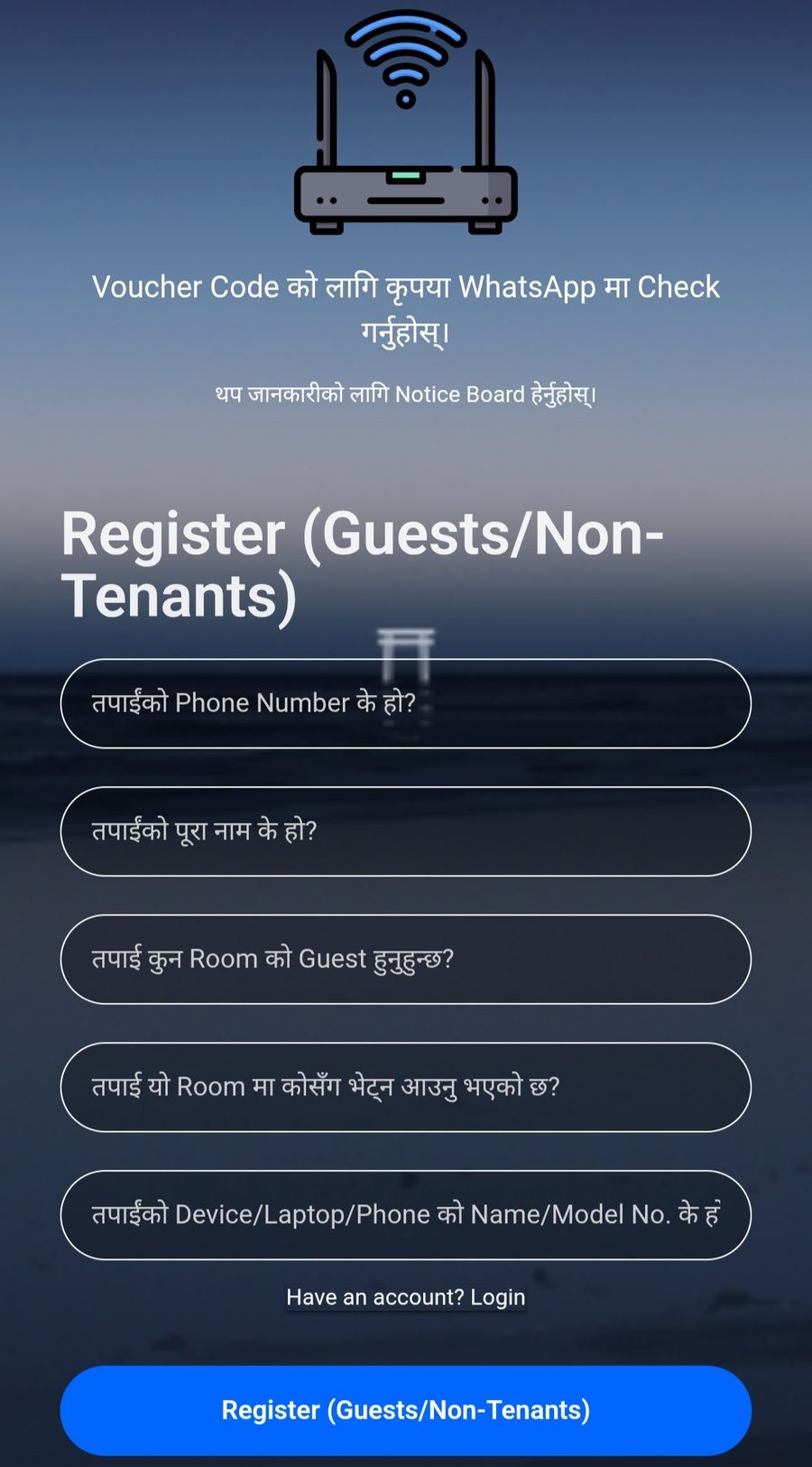
Guest registration form
Guests: Registerfill every field correctly.
4a
Tenants → Account login
On the main screen tap Account, then enter the username and password we sent to your phone by SMS / WhatsApp, and tap Login. That's the default for tenants now — no voucher code needed.
🔑
Lost your username or password? Message us on WhatsApp and we'll resend it.
4b
Guests / visitors → Register
On the main screen tap Register and fill the form — phone number, your name, which room you're visiting, who you're visiting, and your device model. Then tap Register and you're online within a few seconds.
✍️
Fill it in honestly. Accounts registered with fake or incomplete details get disabled after a while. Not sure what your device model is? See “Find your device name” below.
Logging out (when you want to)
Sign out from a device
You don't have to log out — you stay signed in. But if you want to free the session (say, to log in on a different device), open this page and tap Unbind / Logout:
Or type http://lan.auth.reyee.com in your browser.
🏷️Find your device name

The Register form asks for your device model. Here's how to find it on any platform:

Device name / model
# ── Android ──  Settings › About phone › Model number / name
# ── iOS ─────  Settings › General › About › Model Name

# ── Linux ───
hostnamectl
echo "$(cat /sys/class/dmi/id/sys_vendor 2>/dev/null) \
     $(cat /sys/class/dmi/id/product_name 2>/dev/null)"

# ── macOS ───  ⌘ + Space → "About This Mac"
sysctl hw.model
system_profiler SPHardwareDataType

# ── Windows ─  Win + R → msinfo32
Get-WmiObject -Class Win32_ComputerSystem | Select-Object Model
🧩Advanced: your custom DNS token

When your account is created we text you a private DNS token (a DNS address). Setting it applies your personal ad & malware filtering and any content rules on your account. It's optional — skip it if you're not sure.

  1. Go to Settings › Connections › More connection settings.
  2. Tap Private DNS.
  3. Choose Private DNS provider hostname and paste the DNS token from your SMS.
  4. Tap Save. That's it.
iOS needs a small profile to set a custom encrypted DNS. If your SMS includes a configuration profile link, open it in Safari and install it under Settings › Profile Downloaded. Otherwise install a DNS profile app and paste your token — message us and we'll send the exact profile for your account.
PowerShell (admin)
# Windows — set DNS on your active adapter (run in PowerShell as admin).
# Replace the token with the DNS address from your SMS.
Set-DnsClientServerAddress -InterfaceAlias "Wi-Fi" \
  -ServerAddresses ("YOUR-DNS-TOKEN")

# Undo / go back to automatic:
Set-DnsClientServerAddress -InterfaceAlias "Wi-Fi" -ResetServerAddresses
Or set it in the GUI: Settings › Network & internet › Wi-Fi › Hardware properties › DNS server assignment › Edit.
🛡️
Ad & malware blocking already runs network-wide for everyone — the personal token just lets us tailor filtering to your account. No app or subscription needed.
🆘Still stuck? Tell us

Tap the closest one — it opens WhatsApp with a message half-written for you. Just fill the blanks and send.
Track it yourself

Check your data & bill.

On PAYG you pay Rs 1 for every GB — so it helps to see your running total. Your dashboard shows exactly what you've used and what it adds up to, updated daily. No guessing, no surprise bills.

Open your dashboard
1
Go to the usage page & log in
Open the link below and sign in with the same username and password we sent you for Wi-Fi. It works from any browser, on or off our network.
Read your dashboard

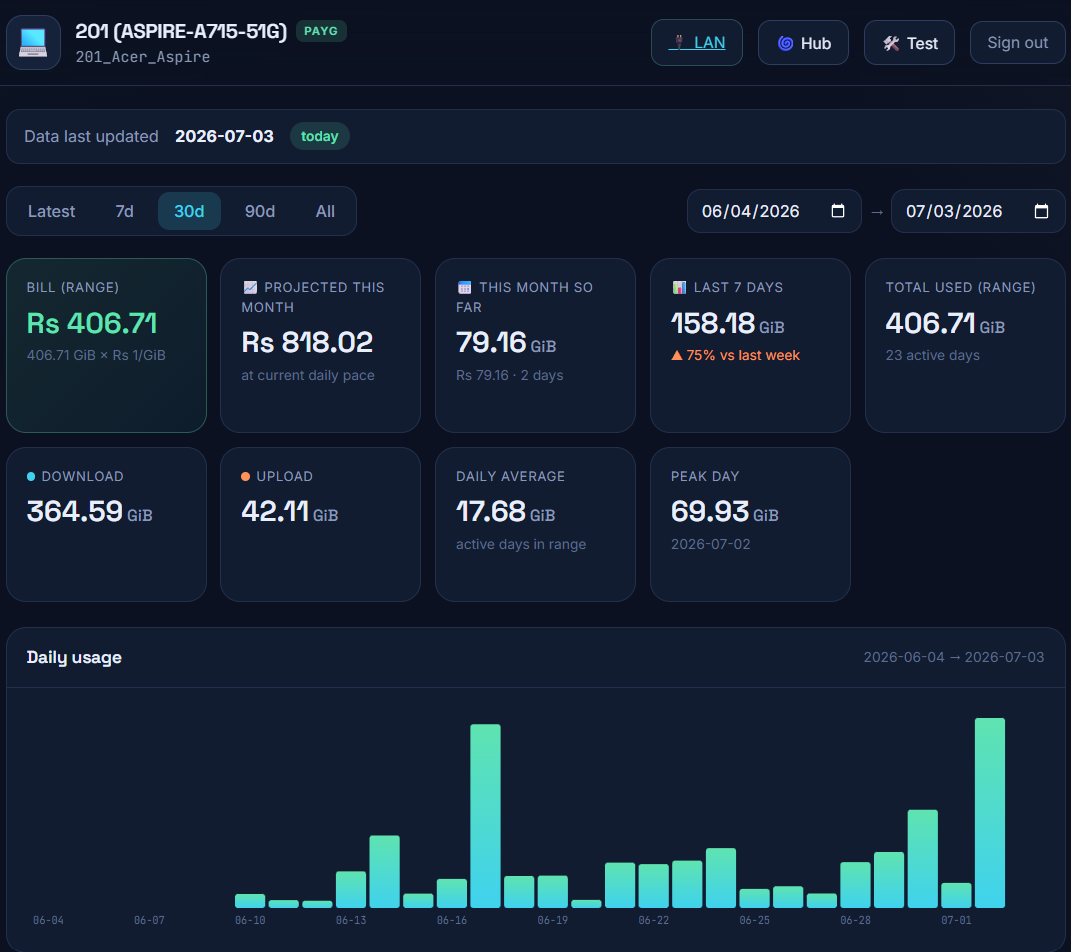
This is what you'll see. The numbers below are just an example:

Example usage dashboard showing bill, download, upload and daily usage chart
ABill (range)what you owe for the period you're viewing, at Rs 1/GB.
BProjected this monthan estimate of the full month if you keep this pace.
CDownload / Uploadhow your data splits between the two.
DDate range & tabsswitch between 7d / 30d / 90d or pick custom dates.
EDaily usage charta bar per day so you can spot heavy days.
FLAN · Hub · Testquick tools: log out a device, hub, and a speed test.
The header shows your room, device and a PAYG tag. “Data last updated” tells you how fresh the numbers are — usually the previous day.
💬Something look off?

If a number doesn't match what you expect, send us your username and what you're seeing — we'll check the logs.

What Rs 1/GB really means.

Mobile data and fixed home lines both cost far more than they look. Here's the honest math against PAYG.

📱 Per GB vs mobile data

Buy data from a carrier and you're paying roughly Rs 30–40 for a single GB. On PAYG a GB is Rs 1.

CarrierPackTheir priceSame data, PAYGEffective /GB
NTC10 GB packRs 300Rs 10Rs 30/GB
vs Rs 1/GB
Ncell8 GB packRs 300Rs 8Rs 37/GB
vs Rs 1/GB

Carrier prices are approximate, last checked Feb 2026. PAYG is billed at a flat Rs 1/GB.

📱 A heavy month (100 GB)

Say you stream and download a lot and burn 100 GB in a month. On carriers that's a small fortune; on PAYG it's Rs 100.

Carrier100 GBTheir pricePAYGYou save / month
NTC100 GBRs 1,000Rs 100Rs 900
Rs 10,800/yr
Ncell100 GBRs 1,500Rs 100Rs 1,400
Rs 16,800/yr

Illustrative. Your actual PAYG bill is always exactly Rs 1 × GB used — check it on the My Usage page.

🌐 vs a fixed home line (500 Mbps)

A comparable 500 Mbps home line is a flat monthly bill whether you use it or not — plus setup, deposit and a 12-month contract. PAYG gives you the same dedicated speed with none of that.

ProviderLineFlat / monthNizamiNet PAYG
WorldLink500 Mbps~Rs 1,550/moRs 1/GB used
DishHome500 Mbps~Rs 2,200/moRs 1/GB used
ViaNet500 Mbps~Rs 2,350/moRs 1/GB used

Provider prices approximate, last checked Feb 2026, and usually exclude setup + deposit. With PAYG a light month can cost a few hundred rupees; a heavy one, whatever your GB add up to.

🔍 Feature for feature

It's not only the price. Here's what's actually included — and what you'd pay extra for elsewhere.

Feature Typical ISP NizamiNet
Pay only for what you use❌ Flat monthly bill regardless of usage✅ Rs 1/GB — a light month costs little
Speed after you use a lot❌ FUP throttling after a hidden limit✅ No personal cap; full 500+ Mbps
Multi-ISP redundancy❌ Single ISP — if it drops, you're offline✅ 3–4 ISPs combined, automatic failover
Uptime during load shedding❌ Goes offline with the power✅ Inverter-backed, stays on
Ad & malware blocking❌ Not included — buy a separate service✅ Built into the network, free
Setup fee / deposit / contract❌ Rs 2,000–5,000+ upfront, 12-mo lock-in✅ None — start and stop anytime
See your live bill❌ Wait for a monthly statement✅ Live dashboard, updated daily

ISP prices approximate, last checked Feb 2026 — verify directly with each provider.

Good questions. Honest answers.

You pay Rs 1 for every GB you use — that's the whole thing. No monthly fee, no minimum. Use 30 GB one month and it's Rs 30; use 300 GB and it's Rs 300. You can watch the total add up live on the My Usage page.
No cap for you. You get dedicated 500+ Mbps and can use as much as you like — you simply pay Rs 1/GB for whatever you use. The only FUP limits are on our upstream ISPs, which our multi-WAN setup handles behind the scenes so you never feel a slowdown. See the Upstream page for the full breakdown.
Open the My Usage guide — or go straight to wifi-check.ajam.dev — and log in with your Wi-Fi username and password. You'll get a dashboard with your running bill, daily usage, download/upload split and a month-end projection — updated daily.
Your account is linked to your device's real MAC address — that's how the network knows it's you across both Wi-Fi bands. A randomized MAC changes constantly, so at best only one network works and at worst you can't log in. Setting your device / permanent MAC fixes it. The Connect page has step-by-step instructions for Android and iPhone.
Each account is tied to one device by default. If you want several devices — phone, laptop, TV — on one account, add a dedicated router (Rs 500/month) and everything behind it shares your line. Data is still billed at Rs 1/GB combined.
Yes — the Ethernet add-on (Rs 100/month) runs a LAN cable to your room for lower, steadier ping. It's worth it for gaming, video calls and big downloads. Your data is still Rs 1/GB.
A normal ISP gives you one line — if it goes down, you're offline. NizamiNet runs 3–4 ISPs at once and reroutes your traffic automatically when one has trouble, so most people never notice. The multi-WAN setup keeps latency steadier (good for gaming and calls), everything is inverter-backed so load shedding doesn't cut you off, and ad + malware blocking is built into the network for everyone.
If you're a tenant here, your PAYG data charges are simply added to your monthly rental bill — nothing separate to pay. Guests and non-tenants settle up over WhatsApp: we take eSewa, Khalti, bank transfer or cash, whatever's easiest. Either way, you can check the exact amount on the My Usage guide first.
Yes. If you're a neighbour or just nearby, tap Activate on WhatsApp and send us your details — full name, phone number, device name/model and device MAC address. We'll set you up and SMS you an account username and password. You'll be on the same Rs 1/GB PAYG as everyone else — no tenancy required.
None. No setup fee, no deposit, no lock-in. On PAYG you only ever pay for the data you actually use, and you can stop anytime — no questions asked.
It rarely does — and when it does you probably won't notice, because 3–4 ISPs run in parallel and the others absorb the traffic instantly. Load shedding is covered by our inverter. If something's genuinely wrong, tap “Internet is down” on the Connect page and it opens WhatsApp with the details half-filled.
Yes. Dedicated bandwidth means KDramas, Netflix, YouTube and live sports don't buffer mid-stream, even in busy evenings. For gaming, the multi-ISP routing keeps ping stable, and the Ethernet add-on gives you a wired line that's noticeably more consistent than Wi-Fi for anything time-sensitive.
💬
Didn't find your answer? Ask us on WhatsApp — real person, usually quick.

Our upstream providers

The part most ISPs never show you: exactly which lines we buy, what they cost us, and how they combine into one fast, always-on connection.

🔄
Multi-WAN aggregation — you never feel the FUP.
Most ISPs throttle speeds by 70–80% after their FUP is hit. Because NizamiNet subscribes to multiple ISPs and routes traffic through whichever lines are below their FUP, users never experience a slowdown. The system balances thresholds in real time, switching lines invisibly.
Total FUP / day
1,100 GB
From daily-FUP ISPs (CGNet + ViaNet + WorldLink)
Combined FUP / month (est.)
≈36 TB
1,100 GB/day × 30 + 2,500 GB (DishHome)
Total upstream cost / month
Rs 9,270
CGNet 3,250 + DishHome 1,250 + ViaNet 2,200 + WorldLink 2,570
ISP Speed FUP Limit Price / Mo Notes
CGNet SOHO
700 Mbps
500 GB/day≈15,000 GB/mo
Rs 3,250 Primary high-speed backbone
DishHome Residential
300 Mbps
2,500 GB/monthMonthly cap
Rs 1,250 Rs 15,000/yr ÷ 12 Monthly FUP failover
ViaNet SOHO
100 Mbps
100 GB/day≈10,000 GB/mo
Rs 2,200 Monthly FUP backup line
WorldLink SOHO
500 Mbps
500 GB/day≈15,000 GB/mo
Rs 2,570 Secondary backbone, wide coverage
📊 Combined ⚡ 1,600 Mbps (~1.5 Gbps+)
📦 1,100 GB/day≈35,500 GB/mo total
🪙 Rs 9,270/mo 📡 Aggregated via multi-WAN router
CGNet SOHO
Rs 3,250/mo
Speed700 Mbps
FUP / day500 GB
FUP / month≈15,000 GB
AnnualRs 39,000
Primary high-speed backbone
DishHome Residential
Rs 1,250/mo
Speed300 Mbps
FUP cap2,500 GB/mo
FUP typeMonthly
AnnualRs 15,000
Monthly FUP backup line
ViaNet SOHO
Rs 2,200/mo
Speed100 Mbps
FUP / day100 GB
FUP / month≈10,000 GB
AnnualRs 26,400
Monthly FUP backup line
WorldLink SOHO
Rs 2,570/mo
Speed500 Mbps
FUP / day500 GB
FUP / month≈15,000 GB
AnnualRs 30,840
Secondary backbone, wide coverage
📊 Combined
Rs 9,270/mo
📦 FUP / day1,100 GB
📦 FUP / month≈36,000 GB
⚡ Speed~1.5 Gbps+
🪙 AnnualRs 1,11,240
📡 ISPs active4
Aggregated via multi-WAN router — traffic routes automatically between all lines

FUP limits are per-ISP. After FUP, most ISPs throttle to 10–30% of plan speed; our multi-WAN system routes to non-FUP'd lines automatically, so users see no slowdown. Prices as of Feb 2026, subject to change.

🌐
How the multi-WAN backend actually works
A smart multi-WAN router monitors all four upstream lines 24/7 and distributes traffic across whichever ISPs still have FUP headroom. When one hits its FUP and throttles, traffic reroutes instantly to the others — transparent to you. The whole setup runs on an inverter, so load shedding doesn't interrupt it. Net result: the combined bandwidth of every line, with none of the FUP penalties.

Network at a glance

Live-ish view of the whole building's traffic — aggregate numbers, not any one person's usage. For your own data, use the My Usage page.

Today
GB used
This Week
GB used
This Month
TB used
Live Rate
Mbps now
Daily Usage — Hourly Breakdown
Building-wide data per hour, today
Today
Weekly Usage — Last 7 Days
Daily totals for the past week
7 Days
Monthly Usage — This Month
Cumulative data used day by day
Month
Peak Download
Peak Upload
Avg Latency
Uptime (30d)